Multi-Cloud Cost Optimisation: A Framework for Indian Enterprises
Written by : Team Accveil

Cloud didn’t quietly increase your IT budget, it rewired it. What once looked like a predictable infrastructure expense has now become a dynamic, constantly moving cost layer spread across multiple providers, services, and teams.
The real challenge is not adoption anymore, it is control. Industry data shows that nearly 27–32% of cloud spend is wasted due to inefficiencies like idle resources and over-provisioning. Yet most enterprises continue expanding their multi-cloud footprint without a clear financial framework.
This is where multi-cloud cost optimisation becomes critical not as a cost-cutting exercise, but as a strategic discipline to align cloud investments with measurable business value.
What Is Multi-Cloud Cost Optimisation?
Multi-cloud cost optimisation is the practice of managing, controlling, and continuously improving cloud spending across multiple cloud platforms. It involves monitoring usage, eliminating waste, optimising resource allocation, and aligning infrastructure costs with business value.
Unlike single-cloud environments, multi-cloud setups introduce additional complexity due to different pricing models, billing systems, and service configurations. Without a unified strategy, enterprises often struggle with fragmented visibility and uncontrolled spending.
A well-defined approach ensures that every workload runs in the most cost-effective environment while maintaining performance, scalability, and compliance.
Why Multi-Cloud Cost Optimisation Matters for Indian Enterprises
Indian enterprises operate in a cost-sensitive yet rapidly scaling digital environment. As organisations adopt hybrid and multi-cloud models, cost management becomes a board-level priority.
The challenge is not just rising cloud bills but the lack of visibility across platforms. Many organisations use multiple providers for different workloads, leading to fragmented cost tracking and inefficiencies. For enterprises still evaluating which cloud platforms to standardise on, working through an AWS vs Azure cloud migration strategy first ensures that workload placement decisions are financially sound from the outset rather than corrected after costs have already escalated.
Additionally, sectors such as BFSI, healthcare, and manufacturing must balance cost optimisation with compliance and performance requirements. This makes hybrid cloud optimisation an essential component of enterprise strategy.
Without structured cost governance, cloud adoption can quickly shift from an enabler of innovation to a source of financial inefficiency.
Key Challenges in Multi-Cloud Cost Management
Understanding the problem is the first step toward solving it. The most common challenges enterprises face are as follows:
- Lack of unified visibility across multiple cloud providers
- Over-provisioned resources and unused infrastructure
- Complex pricing models and billing structures
- Absence of ownership and accountability for cloud spend
- Inefficient workload placement across cloud environments
These challenges directly impact cloud ROI, making it difficult for leadership teams to justify increasing cloud investments.
A Practical Framework for Multi-Cloud Cost Optimisation
1. Establish Cost Visibility and Governance
Start by creating a unified view of cloud spending across all providers. Use tagging, cost allocation, and dashboards to track usage at a granular level. Define ownership by assigning budgets to teams or business units. This ensures accountability and prevents uncontrolled spending.
2. Implement FinOps Practices
Adopt a FinOps (Financial Operations) approach to bring finance, IT, and business teams together. Organisations with structured FinOps practices are significantly more likely to achieve better cost outcomes and improved cloud ROI. Continuous monitoring and collaboration ensure that cost optimisation becomes an ongoing process rather than a one-time activity.
3. Optimise Resource Utilisation
Focus on eliminating waste by right-sizing compute resources, shutting down idle workloads, and optimising storage usage. Automated tools can help identify underutilised resources and recommend actions. Many enterprises achieve up to 20% cost savings through automation and right-sizing strategies.
4. Align Workloads with the Right Cloud
Not all workloads belong on the same cloud platform. Evaluate pricing, performance, and compliance requirements to determine the best environment for each workload. Enterprises that need structured support for this decision can explore multi-cloud cost management for enterprises to see how managed cloud services help distribute workloads intelligently across public and private clouds, ensuring cost efficiency while maintaining performance and compliance.
5. Use Automation and Policy Enforcement
Manual cost management is no longer sufficient. Implement automation to enforce policies such as auto-scaling, scheduled shutdowns, and budget alerts. Automation reduces human error and ensures consistent cost control across environments.
The most effective techniques are as follows:
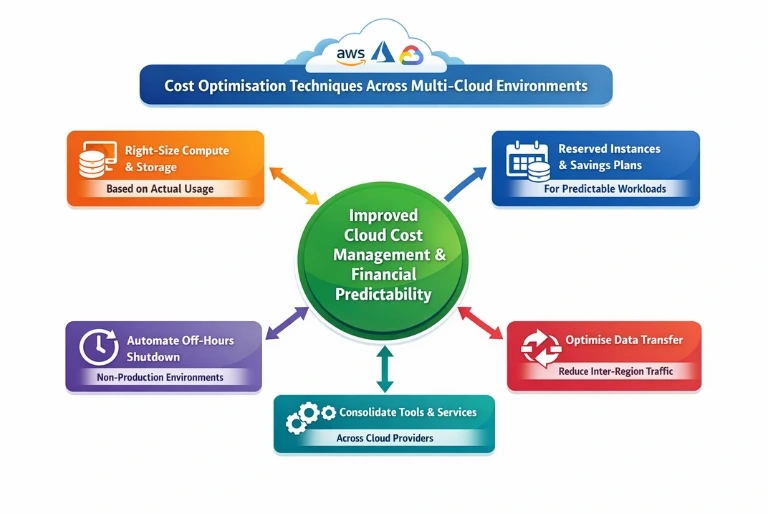
These techniques directly contribute to improved cloud cost management and better financial predictability.
Hybrid Cloude environments are becoming the default model for enterprises. According to recent data, hybrid cloud strategies account for over 50% of enterprise cloud budgets. This model allows businesses to:
- Run predictable workloads on on-premise infrastructure
- Use public cloud for scalability and dynamic workloads
- Maintain control over sensitive data
However, hybrid environments also introduce cost complexity. To optimise effectively, organisations must:
- Avoid unnecessary data transfer between environments
- Use workload profiling to determine the most cost-efficient placement
- Continuously evaluate whether workloads should remain in cloud or move back on-premise
Effective hybrid cloud optimisation ensures that flexibility does not lead to inefficiency.
Optimisation is not just about cutting costs, it is about maximising value. Enterprises that focus only on reducing cloud bills often end up compromising performance, scalability, or innovation. A better approach is to evaluate cloud investments through a value lens:
|
Factor
|
Cost-Focused Approach
|
Value-Focused Approach
|
|---|---|---|
|
Resource Usage
|
Reduce aggressively
|
Optimise based on demand
|
|
Performance
|
May degrade
|
Maintained or improved
|
|
Scalability
|
Restricted
|
Flexible and aligned with growth
|
|
Innovation
|
Slows down
|
Enables experimentation
|
|
Cloud ROI
|
Short-term savings
|
Long-term business impact
|
This distinction is critical. Cloud is not just an infrastructure decision, it is a business enabler. For example, reducing compute capacity may lower costs temporarily, but if it affects application performance, it can lead to customer dissatisfaction and lost revenue. On the other hand, optimising workloads intelligently ensures that resources are used efficiently without impacting outcomes.
The goal of multi-cloud cost optimisation is therefore not minimal spend, but optimal spend, where every rupee contributes to measurable business value.
Bringing It All Together: From Cost Control to Financial Discipline
Multi-cloud environments are inherently complex, but that complexity can be managed with the right approach. The goal is to move from reactive cost tracking to proactive financial discipline. This requires a combination of strategy, tools, and organisational alignment. Enterprises that succeed typically focus on three key principles:
- Visibility : Ensure complete transparency across all cloud environments.
- Accountability : Assign ownership of cloud spending to teams and business units.
- Automation : Use tools to enforce policies and reduce manual intervention.
Another important shift is treating cost optimisation as a continuous process rather than a one-time initiative. Many organisations perform periodic clean-ups, only to see costs rise again within months. Sustainable optimisation requires embedding cost awareness into everyday operations. This is where structured frameworks like FinOps become critical. By aligning finance, IT, and business teams, organisations can ensure that cloud spending decisions are both technically sound and financially viable. In 2026, this shift is no longer optional. Recent industry data shows that 85% of organisations still consider managing cloud spend one of their top challenges, highlighting how difficult it remains to control costs without structured governance and optimisation practices.
Conclusion
Multi-cloud adoption gives enterprises flexibility, scalability, and resilience but without control, it also introduces financial complexity. A structured multi-cloud cost optimisation approach ensures that cloud investments remain aligned with business outcomes, not just technical goals.
By combining visibility, governance, and continuous optimisation, organisations can improve cloud ROI while maintaining performance and scalability.
By combining visibility, governance, and continuous optimisation, organisations can improve cloud ROI while maintaining performance and scalability. For enterprises that want expert support in building this framework for their specific environment, Accveil’s cloud consulting and advisory services help operationalise cost control across cloud migration, managed services, and long-term cloud efficiency planning.
FAQs
How do AI workloads impact multi-cloud cost optimisation?
AI workloads significantly increase cloud costs due to GPU-intensive processing and always-on infrastructure. Recent data shows enterprise AI infrastructure spending grew by 48% year-over-year, making cost optimisation far more complex and critical.
Why is achieving real-time cloud cost visibility difficult in multi-cloud environments?
Each cloud provider uses different billing formats and pricing models, making unified visibility complex. Without integrated tools, enterprises struggle to consolidate data and track costs accurately across environments.
What role does automation play in reducing cloud costs at scale?
Automation enables real-time cost control by shutting down idle resources, enforcing policies, and detecting anomalies instantly, reducing dependency on manual processes that often delay optimisation actions.
How does poor organisational alignment affect cloud cost management?
When finance, IT, and engineering teams operate in silos, cost decisions become reactive. Studies show lack of collaboration is a major barrier to effective FinOps and sustainable cost optimisation.
Why do cloud cost optimisation efforts often fail despite having tools in place?
Most tools provide visibility but not action. Without ownership, governance, and execution frameworks, identified savings opportunities are rarely implemented, limiting real impact on cloud spending efficiency.
Table of Content
- What Is Multi-Cloud Cost Optimisation?
- Why Multi-Cloud Cost Optimisation Matters for Indian Enterprises
- Key Challenges in Multi-Cloud Cost Management
- A Practical Framework for Multi-Cloud Cost Optimisation
- Cost Optimisation Techniques Across Multi-Cloud Environments
- Hybrid Cloud Optimisation: Balancing Cost and Performance
- Cost vs Value: A Strategic Comparison
- Bringing It All Together: From Cost Control to Financial Discipline
- Conclusion
- FAQs