Network Monitoring for Hybrid Environments: Closing 10 Critical Visibility Gaps
Written by : Team Accveil

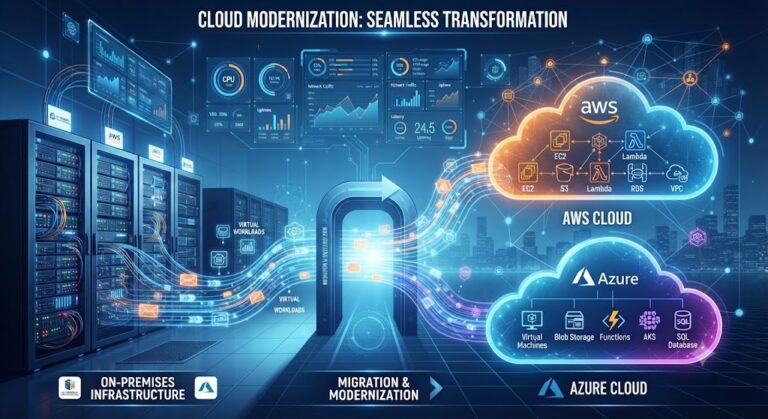
Modern enterprise networks no longer exist in a single environment. They operate across on-premise infrastructure, multiple cloud platforms, SaaS applications, and remote user endpoints. This shift has made network monitoring hybrid cloud environments significantly more complex than traditional setups.
The challenge is no longer just uptime,it is visibility. Recent data shows that 77% of IT teams lack adequate visibility across hybrid environments, while 87% report blind spots across cloud and internet segments.
Without full visibility, performance issues, security threats, and operational inefficiencies remain hidden until they escalate. This is why hybrid network monitoring must evolve from basic device tracking to end-to-end observability.
In this blog, we discuss the 10 most critical visibility gaps and how enterprises can close them using modern monitoring strategies and NMS solutions.
What Is Hybrid Network Monitoring?
Hybrid network monitoring refers to the process of tracking, analysing, and optimising network performance across both on-premise and cloud environments through a unified monitoring approach.
Unlike traditional monitoring, which focuses on static infrastructure, hybrid monitoring must handle dynamic cloud workloads, distributed traffic flows, and multiple platforms simultaneously.
This requires a modern network management system (NMS) that provides real-time insights across environments, correlates data from multiple sources, and enables proactive monitoring. Teams evaluating which platforms deliver these capabilities across scale should refer to a detailed comparison of the best enterprise network monitoring tools to understand how options differ across deployment models and feature depth.
Without this unified visibility, IT teams operate in silos, making it difficult to detect issues, resolve incidents quickly, or maintain consistent performance across the network.
Why Hybrid Network Visibility Is a Critical Priority
Do not treat visibility as a technical enhancement, treat it as an operational requirement. Hybrid environments introduce multiple failure points. A single user request may pass through on-prem servers, cloud workloads, APIs, and third-party services. Without end-to-end monitoring, identifying where issues occur becomes difficult. Industry insights highlight that:
- Only 20% of teams have deep packet-level visibility in public cloud environments
- Most organisations struggle with fragmented monitoring tools and siloed data
This lack of visibility impacts:
- Incident response time
- Application performance
- Security detection
- User experience
Hybrid network monitoring ensures that IT teams can track performance across the entire network path, not just individual components.
What Capabilities Should Infrastructure Teams Prioritise When Evaluating Network Management Tools for Hybrid Environments?
Infrastructure teams evaluating NMS tools for hybrid environments often focus on feature lists without accounting for the specific demands of mixed architectures. The capabilities below are the ones that directly determine whether a tool can deliver consistent visibility at scale across hybrid infrastructure.
- Unified cross-environment visibility: The tool must provide a single monitoring pane that covers on-premise devices, cloud workloads, SaaS platforms, and remote endpoints simultaneously not separate dashboards stitched together manually.
- Cloud-native workload support: Look for native integrations with major cloud providers such as AWS, Azure, and GCP. The tool must handle auto-scaling workloads, containerised environments, and dynamic IP changes without losing track of monitored assets.
- End-to-end network path analysis: The tool should trace traffic across the full delivery path, from user endpoint through internal network, cloud gateway, and application layer. Visibility limited to any single segment creates blind spots in diagnosis.
- Real-time alerting with intelligent noise reduction: Hybrid environments generate high alert volumes. Prioritise tools that correlate alerts across systems, suppress duplicates, and surface only high-priority incidents to reduce analyst fatigue.
- East-west traffic monitoring: Internal traffic between services and workloads is as important as perimeter traffic. The tool must provide visibility into lateral movement within the hybrid environment, not just ingress and egress.
- Encrypted traffic inspection capability: As encryption becomes universal, teams need tools that can analyse traffic metadata and behavioural patterns without compromising security policy, maintaining visibility without breaking encryption.
- Integration with security and ITSM tools: Monitoring tools that connect natively with SIEM platforms, ticketing systems, and security tools create a coordinated response capability rather than isolated data streams.
- Automated root cause correlation: Manual diagnosis across distributed environments is slow. Tools that automatically correlate events across network, application, and infrastructure layers reduce mean time to resolution significantly.
- Scalable architecture for infrastructure growth: Evaluate whether the tool can scale without requiring re-architecture as cloud footprint, device count, or user load increases over time.
- Role-based access and cross-team dashboards: Hybrid environments involve network, cloud, security, and DevOps teams. Tools that support shared dashboards with role-based views improve coordination and reduce the friction caused by fragmented ownership.
Evaluating tools against these capabilities, rather than general feature lists, ensures that the selected platform can handle the actual complexity of a hybrid environment rather than just the simpler scenarios it was designed to demonstrate.
The 10 Critical Visibility Gaps in Hybrid Environments
Hybrid environments create multiple blind spots that impact performance, reliability, and security. These gaps must be addressed systematically.
1. Fragmented Visibility Across Environments
Most organisations use separate tools for cloud and on-premise systems. This leads to siloed data and disconnected insights. When a performance issue occurs, teams cannot correlate data across environments. This results in slower troubleshooting and incomplete diagnosis. Unified visibility is essential to understand how systems interact across the hybrid architecture.
2. Lack of End-to-End Network Path Visibility
Monitoring tools often focus on individual components rather than the complete data path. In hybrid environments, traffic moves across multiple layers: on-prem servers, cloud workloads, APIs, and external services. Without full path visibility, identifying latency or failure points becomes difficult. This directly impacts SLA performance and user experience.
3. Difficulty in Root Cause Analysis
Hybrid environments generate massive volumes of logs and metrics. When issues occur, teams struggle to determine whether the problem lies in the network, application, infrastructure, or cloud provider. This leads to longer resolution times and increased downtime, especially during critical incidents.
4. Isolated Data Across Monitoring Tools
Many enterprises use multiple tools for different environments cloud, network, applications. While each tool provides insights, they do not communicate effectively. This creates fragmented visibility and slows down decision-making. Instead of improving monitoring, tool sprawl often increases complexity.
5. Limited Visibility into Cloud-Native Workloads
Traditional monitoring tools are not designed for dynamic cloud environments. Cloud workloads scale automatically, change frequently, and operate across distributed systems. Without cloud-native monitoring capabilities, visibility becomes inconsistent. This results in blind spots in performance tracking and resource utilisation.
6. Alert Fatigue and Noise
Hybrid environments generate large volumes of alerts from different systems. Many of these alerts are repetitive or low priority. This overwhelms IT teams and reduces their ability to identify critical issues. Alert fatigue leads to slower response times and missed incidents.
7. Blind Spots in East-West Traffic
Most monitoring focuses on incoming and outgoing traffic. However, in hybrid environments, a significant portion of activity happens internally between systems, services, and workloads. Without visibility into this east-west traffic, performance issues and threats can move undetected within the network.
8. Encrypted Traffic Limiting Visibility
Encryption improves security but reduces visibility into network traffic. Traditional monitoring tools cannot inspect encrypted data effectively, creating blind spots where threats may go unnoticed. Organisations must balance security and visibility to maintain effective monitoring. Teams managing active cloud migrations should also assess securing hybrid workloads during cloud migration, since the transition period is when encrypted traffic blind spots are most likely to be exploited.
9. Lack of Real-Time Monitoring
Many organisations still rely on delayed reporting or periodic checks. In dynamic hybrid environments, delays in detection can lead to rapid escalation of issues. Real-time monitoring is essential to identify and resolve problems before they impact operations.
10. Fragmented Ownership Across Teams
Hybrid environments involve multiple teams network, cloud, security, DevOps. Without clear ownership, issues take longer to resolve as teams depend on each other for data and actions. This lack of accountability creates operational inefficiencies and delays incident resolution. Organisations that are weighing whether to consolidate this function internally or through external support will find it useful to compare the trade-offs in a managed IT services vs in-house IT team evaluation before committing to a resourcing model.

Closing Visibility Gaps: What Effective Monitoring Looks Like
Closing these gaps requires a shift from fragmented monitoring to a unified strategy. Instead of adding more tools, organisations must focus on integration, automation, and centralisation. A modern approach includes:
- Implementing unified NMS Solutions for end-to-end visibility.
- Integrating monitoring across cloud, network, and applications.
- Using intelligent alerting to reduce noise
- Enabling real-time monitoring and automated responses.
- Establishing clear ownership across teams.
To understand the difference, consider the following:
|
Capability
|
Fragmented Monitoring
|
Unified Hybrid Monitoring
|
|---|---|---|
|
Visibility
|
Limited to specific tools
|
End-to-end across environments
|
|
Alerting
|
High noise and duplication
|
Intelligent and prioritised
|
|
Troubleshooting
|
Slow and manual
|
Faster with correlation
|
|
Scalability
|
Limited
|
Supports hybrid growth
|
|
Operations
|
Reactive
|
Proactive monitoring
|
To sustain long-term visibility, organisations must build a monitoring strategy that evolves with their infrastructure.
Start by consolidating tools and creating a single source of truth. Fragmented monitoring systems increase complexity and reduce efficiency. In fact, industry data shows that 55% of IT teams identify tool sprawl as a major barrier to effective monitoring, making consolidation a priority for hybrid environments.
Next, align monitoring with business outcomes. Focus on uptime, performance, and user experience rather than isolated device-level metrics. This ensures that monitoring directly supports operational goals rather than functioning as a technical activity.
Automation plays a critical role here. Automated alerts, anomaly detection, and response mechanisms reduce manual intervention and help teams respond faster to incidents.
Equally important is cross-team collaboration. Hybrid environments involve network, cloud, and security teams, and without alignment, visibility remains fragmented. Establish shared dashboards, common metrics, and clear ownership to improve coordination.
Finally, adopt integrated solutions that combine monitoring, analytics, and automation.
A global manufacturing enterprise operating across on-premise data centres and cloud platforms like Azure and Zscaler faced major visibility challenges in its hybrid environment. The organisation relied on multiple security and monitoring tools, which resulted in fragmented visibility and inconsistent policy management across systems. The key issues included:
- Lack of unified visibility across cloud and on-premise environments
- Manual monitoring and compliance processes
- Increasing operational complexity requiring additional IT resources
- Delays in identifying and resolving network and security issues
To address this, the organisation implemented a centralised monitoring and management platform that provided a single view across all environments. This unified approach enabled real-time visibility into network activity, automated policy management, and continuous monitoring. After implementation, the organisation achieved:
- End-to-end visibility across hybrid infrastructure
- 81% reduction in time spent on compliance tasks
- $1 million annual cost savings through automation
- Elimination of the need to hire additional IT staff for monitoring and audits
This case highlights a critical insight: visibility gaps in hybrid environments are not caused by lack of tools, but by lack of integration and centralisation.
Conclusion
Closing visibility gaps in hybrid environments is no longer optional, it is essential for maintaining performance, security, and operational efficiency. A well-structured network monitoring hybrid cloud strategy enables organisations to move from reactive issue handling to proactive control, ensuring consistent visibility across distributed systems.
To achieve this at scale, organisations must adopt unified monitoring frameworks, integrate tools, and align teams around a single source of truth. Accveil supports enterprises through its expertise in managed services, enterprise networking, and IT infrastructure. To see how this translates into practice for your environment, explore our NMS solutions and network visibility services and take the first step toward a fully visible, proactively managed hybrid network.
FAQ
Why do visibility gaps increase in hybrid environments?
Hybrid environments combine multiple platforms, tools, and traffic paths, making it difficult to track data flow consistently. This leads to fragmented visibility and delayed issue detection.
How does unified monitoring improve network visibility?
Unified monitoring integrates data from multiple environments into a single platform, enabling real-time insights, faster troubleshooting, and better decision-making across hybrid networks.
What is the role of automation in hybrid network monitoring?
Automation helps detect anomalies, reduce manual effort, and respond to issues faster, improving operational efficiency and reducing downtime in complex hybrid environments.
Can traditional monitoring tools handle hybrid environments effectively?
No, traditional tools are designed for static infrastructure and lack the capability to monitor dynamic cloud workloads and distributed systems effectively.
What should organisations prioritise when improving hybrid network visibility?
Organisations should focus on unified monitoring platforms, real-time visibility, automation, and cross-team collaboration to ensure complete network observability.
Table of Content
- What Is Hybrid Network Monitoring?
- Why Hybrid Network Visibility Is a Critical Priority
- The 10 Critical Visibility Gaps in Hybrid Environments
- Closing Visibility Gaps: What Effective Monitoring Looks Like
- Building a Scalable Hybrid Monitoring Strategy
- Case Study: Achieving Hybrid Network Visibility in a Manufacturing Enterprise
- Conclusion
- FAQ