Beyond Lift-and-Shift: Modernizing Enterprise Workloads with AWS and Azure
Written by : Team Accveil
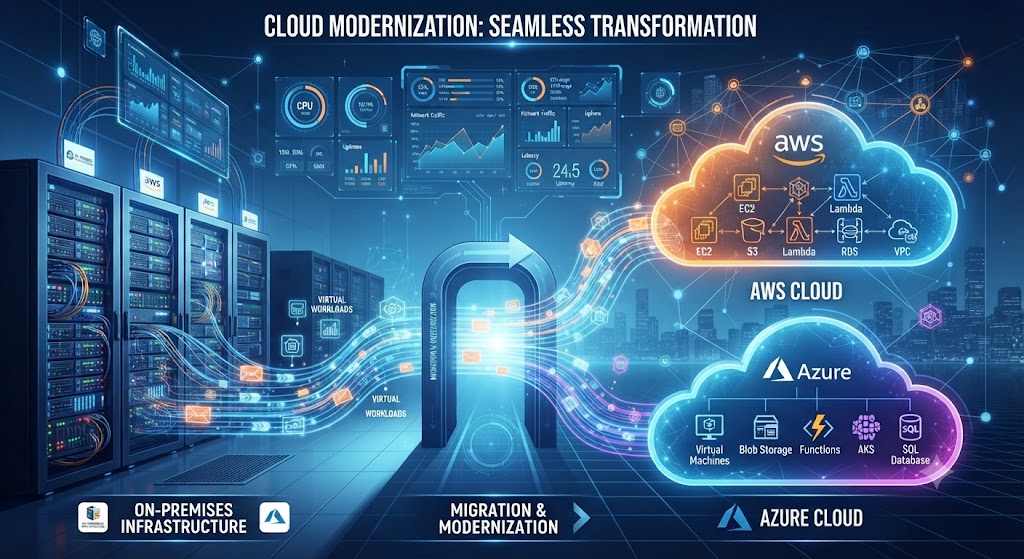
For years, the mandate for enterprise IT was simple: get to the cloud. In the rush to migrate, many organizations relied heavily on the “lift-and-shift” approach—moving on-premises virtual machines directly into the cloud without modifying the underlying architecture. While this strategy offers a fast exit from aging data centers, it often results in “cloud debt.” Lift-and-shift migrations frequently fail to capitalize on cloud-native scalability, leading to monthly bills that match or even exceed legacy infrastructure costs.
To unlock true ROI, modern enterprises must move beyond merely hosting servers in someone else’s data center. By strategically replatforming and re-architecting workloads for platforms like Amazon Web Services (AWS) and Microsoft Azure, organizations can achieve up to a 40% reduction in IT costs while securing 99.9% system availability.
Aligning the Right Workload with the Right Cloud
Not every application belongs in the cloud, and those that do shouldn’t all move the same way. A successful modernization strategy begins by evaluating the specific strengths of the major cloud providers against your existing tech stack:
- Microsoft Azure (The Hybrid Powerhouse): Azure is the natural choice for enterprises heavily invested in the Microsoft ecosystem. Because it offers seamless native integration with Office 365, Active Directory, and Windows Server, hybrid deployments become highly straightforward. It is the premier destination for moving legacy Exchange servers or migrating heavily customized Microsoft Dynamics environments.
- Amazon Web Services (The Scalability Engine): AWS boasts the broadest service catalog, making it ideal for large-scale, data-intensive workloads. Organizations looking to completely re-architect applications into microservices, containerize workloads, or integrate deep AI/ML capabilities typically find AWS to be the most flexible environment for custom development.
Many modern enterprises ultimately adopt a multi-cloud strategy, utilizing Azure for their core enterprise apps and identity management, while leveraging AWS for customer-facing web applications and big data analytics.
Accveil’s 6-Phase Cloud Migration Methodology
Executing a seamless migration—whether replatforming databases to managed services or fully refactoring monolithic applications into serverless architectures—requires extreme precision. Accveil ensures zero data loss and minimal downtime through a rigorous 6-phase migration methodology:
Discovery & Assessment: A comprehensive analysis of your current infrastructure, mapping all application dependencies to determine which of the “6 Rs” (Rehost, Replatform, Refactor, Repurchase, Retire, Retain) applies to each workload.
Planning & Design: Designing the target cloud architecture, defining migration waves, and establishing strict runbooks to ensure security and compliance are baked in from day one.
Environment Setup: Building secure cloud landing zones, configuring identity integration, setting up advanced networking (such as VPNs or Azure ExpressRoute), and deploying guardrails.
Migration Execution: Moving workloads in phased waves and executing continuous data synchronization to prevent operational disruption.
Validation & Cutover: Conducting thorough performance validation and user acceptance testing before a highly controlled production cutover.
Optimization & Support: The migration doesn’t end at cutover. Post-migration governance involves rightsizing resources, implementing reserved instances, and fine-tuning the environment to ensure predictable cloud spending.
Eliminating the "Quarterly Cloud Surprise"
One of the most common pitfalls of DIY cloud migrations is cost sprawl. When legacy applications are migrated as-is, they consume cloud compute resources 24/7, even during off-peak hours.
By taking a modernization-first approach, workloads are adapted to consume resources only when needed. Implementing managed database services, auto-scaling groups, and containerization ensures you pay strictly for what you use. When combined with upfront cost governance, tagging strategies, and budget alerts configured during the environment setup phase, cloud spending becomes a predictable operational asset rather than a liability.
Transforming your IT infrastructure from a cost center into a growth engine requires strategic planning and flawless execution. A thorough Cloud Assessment provides a clear roadmap, precise architecture diagrams, and accurate TCO projections before a single workload is moved.
FAQ
What is the main difference between "lift-and-shift" and cloud modernization?
Lift-and-Shift (Rehosting): Involves moving your existing on-premises virtual machines and applications directly to the cloud infrastructure with little to no architectural changes. While fast, it often leads to high operational costs and fails to leverage native cloud capabilities.
Cloud Modernization (Replatforming/Refactoring): Involves optimizing or redesigning application code and architecture to utilize cloud-native services (such as managed databases, containers, and serverless compute), resulting in superior performance, greater scalability, and lower long-term costs.
How do I decide whether to migrate my workloads to Microsoft Azure or Amazon Web Services (AWS)?
Choosing the right platform depends on your existing tech stack and strategic goals:
Microsoft Azure is ideal for organizations deeply integrated into the Microsoft ecosystem (e.g., Windows Server, Office 365, Active Directory, and SQL Server) because it provides seamless hybrid integration and robust enterprise compliance features.
Amazon Web Services (AWS) offers the broadest service catalog and deepest infrastructure flexibility, making it exceptionally well-suited for large-scale web applications, microservices, big data, and custom AI/ML development. Many enterprises choose a multi-cloud approach to leverage the distinct strengths of both platforms.
How does Accveil ensure zero data loss and minimal downtime during a cloud migration?
Accveil follows a strict, 6-phase migration methodology that begins with a thorough Discovery & Assessment to map all application dependencies. During execution, we use phased migration waves and continuous data synchronization techniques to keep production environments running smoothly, followed by rigorous validation before final cutover.
How can modernization help prevent unexpected or high cloud bills?
Unoptimized lift-and-shift migrations often leave virtual machines running 24/7, leading to “cloud debt.” Modernization addresses this by implementing automated scaling, managed services, and right-sized resource allocation so you only pay for what you actually use. Coupled with ongoing cost governance, tagging, and budget alerts, cloud expenditures become completely predictable.
What kind of business outcomes can we expect after moving to a modern cloud architecture?
When properly optimized and managed, modern cloud architectures deliver significant operational enhancements, including up to a 40% reduction in infrastructure and management costs, 99.9% system availability (uptime SLAs), and the agility to scale resources up or down instantly in response to market demands.
No. Accveil takes complete end-to-end ownership of the transition. Our experts handle everything from the initial application and hardware assessment to a seamless, zero-data-loss migration, followed by round-the-clock managed support and ongoing optimization.
Table of Content
- Overview : Modernizing Enterprise Workloads
- Aligning the Right Workload with the Right Cloud
- Accveil’s 6-Phase Cloud Migration Methodology
- Eliminating the "Quarterly Cloud Surprise"
- FAQ