Network Monitoring for Hybrid Environments: How We Close 10 Critical Visibility Gaps
Written by : Team Accveil

Your IT department sees green dashboards via healthy status checks of AWS CloudWatch while customer checkout pages time out silently within the local server environment. That’s the expensive truth about depending on legacy solutions in a split enterprise environment. Splitting your data across a local data center and public cloud platform causes traditional monitoring solutions to fail. Based on a study by Flexera in the 2024 State of the Cloud Report, organizations are wasting 29% of their cloud spend because of poor architectural design and inefficient resource loop management.
In the modern enterprise environment, there should be complete hybrid network monitoring to ensure transient blind spots aren’t created within your entire footprint. With a lack of a centralized and high-performing solution, systemic blindness will cause degradation in application performance. Enterprise teams need an adaptive NMS hybrid environment approach.
What is hybrid network monitoring?
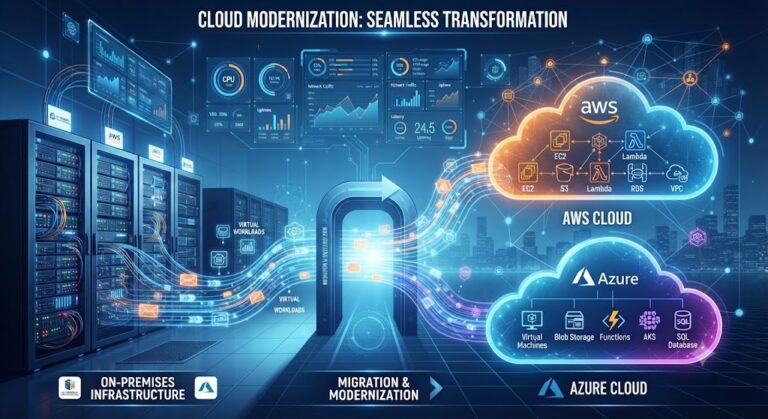
Hybrid network monitoring means combining live performance observing within local infrastructure, private clouds, and public cloud platforms to get a single operational view. It helps to visualize complex data paths and dependencies between local servers and cloud environments, so that no performance issues are missed during traffic handoffs. With this all-round method, IT departments can follow data packets moving across physical and virtual boundaries without any trouble.
The Core Challenge of Cross Platform Infrastructure Complexity
Controlling today’s corporate infrastructure creates serious operational challenges. Data moves through physical firewalls, Cisco routers at the premises, and cloud boundaries. In the absence of dedicated network monitoring tools, engineers blindly work through disconnected systems.
• Serious Bottleneck Issues: Slowing of network traffic occurs at points where systems connect with each other. Legacy siloed systems are incapable of detecting bottlenecks between local connections and cloud systems.
• Operational Challenges in Monitoring: Engineers waste their precious time looking for issues separately in disconnected systems. The process of isolation becomes lengthy during major disruptions.
• Exorbitant Costs Incurred due to Clouds: Erroneous configurations make applications ask for the same piece of data repeatedly, leading to budget overruns. The lack of transparency does not help in identifying inefficient paths.
1. The Blind Spot Between Physical Architecture and Cloud Borders
Connections between local offices and public cloud providers have proven tricky to monitor. The usual methods for monitoring examine internal server connections but do not consider the connections used for transit. Hybrid network monitoring provides an accurate solution to this problem by looking at connections across borders.
• Mid Transit Latency Monitoring: Typically, performance degrades on public internet connections that connect the systems together. Network visibility monitoring will highlight problems with mid transit latency.
• ISP Connectivity Issues: We had one client, a retailer, with an ongoing problem of silent checkout timeouts that occurred for three weeks before we were able to detect this problem using our unique monitoring system: severe mid-transit latency issues on their local ISP connection.
• Tunnel Bandwidth Limits: Tunneling can create significant problems when the amount of data passing through suddenly increases. Hybrid monitoring monitors tunnel bandwidth usage to avoid major connectivity issues.
2. Mean Time to Resolution and the IT Finger-Pointing Loop
In cases where critical applications start experiencing performance issues, the different engineering groups tend to shift blame among themselves, where local server admins blame the cloud provider, and the cloud providers blame the local infrastructure. The use of a centralized system for hybrid cloud monitoring puts an end to such situations.
• Unified Root Cause Mapping: With integration of tracking data, it becomes easier to track the journey of every request made by users, which enables one to pinpoint the specific cause of performance problems.
• No More Blame Games: Through the use of common metrics, both infrastructure and Site Reliability Engineers can agree on the same source of truth, allowing them to concentrate on solving the issue rather than transferring blame for any technical problem.
• Automated Technical Triage: A smart monitoring platform ensures that technical issues get routed to the right specialist groups almost immediately.
3. Exploding Transit Bills and Unoptimized Resource Routing
Being in a multi cloud environment is associated with paying for each byte of data movement. Unoptimized applications lead to excessive cross-border traffic, resulting in increased bills. Hybrid network monitoring helps detect such hidden costs.
• Identifying High Cost Data Loops: Applications tend to access the same data sets repeatedly. With high quality monitoring, these data loops become visible, helping developers optimize local caches.
• Egress Data Cost Monitoring: The transfer of data from the public cloud is always charged. Monitoring enables real-time detection of the increase in egress data.
• Proper Cloud Instance Allocation: Over-allocation of cloud instances causes waste of considerable infrastructure resources. Metrics provide exact figures on the reduction of idle infrastructure.
4. Sophisticated Security Exploits Hiding Inside Legitimate Traffic Flows
Most modern cyber attacks do not rely on overt attack mechanisms to gain entry into corporate networks. Cybercriminals will search for any security loopholes within the intricate, busy nature of data flow within infrastructures. It is therefore crucial for organizations to have high visibility of their infrastructures.
• Creating Traffic Baselines Using Machine Learning: Automated machine learning solutions create baseline levels of traffic across various enterprise channels. Unusual traffic patterns can thus easily be identified.
• Identification of Data Exfiltration: According to the findings of the 2021 Cost of a Data Breach Report by IBM, detection of any data breach takes on average 277 days. Monitoring is done continuously to detect unusual late-night bulk uploads to other servers.
• Lateral Movements Detection: After gaining entry, intruders will try to move laterally by hopping from cloud systems to local backup drives.

5. The Encrypted Traffic Blind Spot and Hidden Malware Payloads
Corporate privacy can be ensured by encrypting most information exchanged over the internet by companies. Attackers are aware of the encryption process, and they exploit it to bypass traditional scanners. Modern monitoring tools must analyze traffic fingerprints without decryption.
• Cryptographic metadata tracking: These dedicated tools examine packet sizes and timestamps. The fingerprints identify malicious activities that exist within encrypted tunnels.
• Cipher suite auditing: Older encryption protocols make companies’ data vulnerable to breaches. Constant monitoring ensures that every active connection is compliant with current security protocols.
• Certificate expiration notifications: Certificate expiration results in application failures due to unexpected outages. Automation tools generate timely notifications ahead of expiration deadlines.
6. Fragmented Dashboards and the Operational Blindness Crisis
The decision to make your engineers view five distinct software applications represents a huge security risk. Contrary to isolated tools like AWS CloudWatch and Azure Monitor, a unified solution gives you all the data visibility needed. The new-generation NMS hybrid environment brings all the screens under one roof.
• Single Pane View Efficiency: Having your local routers, cloud-based routers, and edge routers on one dashboard increases concentration. Your engineers monitor health metrics for all platforms at once.
• Customizable Executive Dashboards: The unified management solution simplifies your technical data by delivering a business-oriented interface. Executives can monitor metrics on availability and user experiences without having to deal with code lines.
• Normalized Metrics Across All Platforms: A unified solution will merge your performance metrics from different cloud solutions. You will get an opportunity to compare all your monitoring metrics across your infrastructure.
7. The Microservices Maze and Transient Container Monitoring
Contemporary implementations rely on independent microservices that boot and shut down in seconds to accommodate web traffic. To keep track of these rapidly evolving processes, one needs advanced hybrid cloud monitoring technologies.
• Real Time Topology Discovery: The discovery engine automatically keeps track of the evolving network of interlinked microservices. This creates a detailed map of your application’s current connections.
• Inter Service Latency Monitoring: Delayed interaction among individual microservices can negatively affect user speed. Monitoring tools track delays between different containers to reveal hidden performance issues.
• Orphaned Resource Removal: During testing, many temporary containers are created which may run even after the project is completed. Monitoring technology identifies these useless containers for prompt removal.
8. Alert Fatigue and the Danger of Ignored System Warnings
However, the inundation of unnecessary alerts by monitoring systems renders emergencies unnoticeable. According to the 2023 State of Security report by Splunk, 70 percent of security teams suffer from severe alert fatigue, resulting in critical alert misses.
• Intelligent Alert Suppression: Advanced monitoring systems prevent multiple alert notifications in response to significant network outages. Thus, one broken switch cannot result in countless duplicated email notifications.
• Variable Alert Thresholds: Static thresholds will cause many false alert notifications during regular afternoons’ network usage peak periods. Intelligent alerting adjusts alerts depending on the regular time of the day utilization.
• Alert Priority Depending on Impact Level: The system considers important customer checkout problems over the company’s internal test problem.
9. The User Experience Disconnect and Misleading System Metrics
Whereas your internal server metrics could indicate 100% uptime, your customers could be experiencing incredibly poor page load times. The solution to this problem involves the analysis of actual user experience metrics.
• Synthetic Transaction Testing: Bots automate testing by carrying out tasks that would otherwise be performed by real people, including signing into a website and making purchases.
• Real User Performance Metrics: Tools track actual performance based on real page load times from customer web browsers for different devices and networks.
• Network Logs and User Experience: Connecting extensive network logs to page load times will enable developers to pinpoint precisely which database operation causes issues.
10. The Shadow IT Trap and Untracked Cloud Environments
Staff members often disregard the security guidelines of their organizations by using non sanctioned cloud applications for accelerating their workflow. This creates an enormous amount of security vulnerabilities that go unnoticed within enterprises.
• Automated App Discovery: The scanning process uncovers all third party applications communicating with your organization’s data on a continuous basis.
• Data Endpoint Security: Identifying unsanctioned file-sharing apps enables organizations to prevent any data leakage from happening.
• Compliance Software: Ensuring the compliance of all software programs within the company enables compliance management teams to adhere to data protection standards in the industry.
Platform Capability Comparison
Capability | Accveil | AWS CloudWatch | Azure Monitor |
Cross-Border Hybrid Topology | Full end-to-end visualization across on-premises and clouds | Cloud-centric; manual setup required for local infrastructure | Cloud-centric; requires custom agents for on-premises hardware |
On-Premises Hardware Visibility | Native support for SNMP, NetFlow, and legacy switches | Restricted to basic agent-supported metrics | Limited; highly dependent on specific Azure Arc configurations |
Egress Cost Tracking | Real-time cross-platform data loop cost optimization | Tracks internal AWS budgets without external context | Tracks internal Azure budgets without external context |
Correlated Root Cause Analysis | Unified mapping across physical and virtual layers | Siloed to AWS resource dependencies | Siloed to Azure ecosystem dependencies |
Un-decrypted Threat Auditing | Advanced cryptographic fingerprint metadata analysis | Basic protocol-level checking | Basic protocol-level checking |
Conclusion
Removing such visibility blind spots demands a partner who goes beyond mere tracking software. Mean Time to Resolution (MTTR) essentially quantifies how long on average it takes a team to pinpoint a problem, make the repair and fully get a broken system or network piece working again; typically the industry’s ready reference point for such complicated cross-border outages is about 4 to 6 hours. Accveil has provided solutions for more than 200 enterprise organizations to achieve 60% lower mean time to resolution through integrated hybrid monitoring pipelines. With the use of an integrated infrastructure visibility environment, Accveil ensures that you don’t have a fragmented dashboard anymore but get a centralized command center.
Key Takeaways for Enterprise Leaders
• Apply Holistic Monitoring: Avoid disparate monitoring tools and use holistic hybrid cloud monitoring to see all your infrastructure within one interface.
• Uncover Invisible Latencies: Gain insight through deep network visibility hybrid cloud tracking to spot performance bottlenecks between local equipment and cloud resources.
• Manage Your Infrastructure Cost: Through analytics, monitor your infrastructure cost and prevent unnecessary costs of transferring information to the cloud.
• Manage Alerts Effectively: Ensure engineers don’t get burnt out by creating systems that focus on important business alerts.
• Work with Accveil for Scalability: Keep your digital assets safe using Accveil’s expertise with cloud services to maximize system availability.
FAQ
What is the key feature of hybrid network monitoring vs. traditional monitoring?
The hybrid approach analyzes data transfer processes within both environments concurrently and covers visibility blind spots caused by transferring information from one corporate platform environment to another.
How does an NMS hybrid environment contribute to lowering alert fatigue in IT departments?
The NMS hybrid environment employs intelligent correlation filters and dynamic metric thresholds, ensuring that no thousands of individual notifications are generated for each occurrence in the infrastructure. In turn, engineers only receive critical alerts for their attention.
Why can't native cloud monitoring software be used for hybrid cloud monitoring?
Native solutions such as AWS CloudWatch or Azure Monitor cannot cover visibility of your on-premises hardware switches, local firewalls, or even third-party ISP links. A dedicated hybrid cloud monitoring tool covers multiple networks in one comprehensive overview.
Why does infrastructure visibility tracking help lower hidden cloud expenses?
Siloed solutions do not trace data loops wherein applications request unnecessary information transfers constantly. Infrastructure visibility helps identify these inefficient data loops to avoid paying excessive egress charges for data transfer operations.
Table of Content
- What is hybrid network monitoring?
- The Core Challenge of Cross-Platform Infrastructure Complexity
- 1. The Blind Spot Between Physical Architecture and Cloud Borders
- 2. Mean Time to Resolution and the IT Finger-Pointing Loop
- 3. Exploding Transit Bills and Unoptimized Resource Routing
- 4. Sophisticated Security Exploits Hiding Inside Legitimate Traffic Flows
- 5. The Encrypted Traffic Blind Spot and Hidden Malware Payloads
- 6. Fragmented Dashboards and the Operational Blindness Crisis
- 7. The Microservices Maze and Transient Container Monitoring
- 8. Alert Fatigue and the Danger of Ignored System Warnings
- 9. The User Experience Disconnect and Misleading System Metrics
- 10. The Shadow IT Trap and Untracked Cloud Environments
- Platform Capability Comparison
- Conclusion
- Key Takeaways for Enterprise Leaders
- FAQ